

Loot Mechanics: How Much You Can Actually Steal
Mechanics
Updated: 18 September 2026 · By the Goblins Farm team
The number on the search screen is not the defender's bank balance. It is a calculated slice, and the slice is calculated very differently depending on where the resources are sitting. Understanding that one distinction is the single biggest jump in farming efficiency most players ever make.
The two loot pools
Every base you attack holds resources in two fundamentally different places, and the game treats them under different rules.
Collector loot lives in gold mines, elixir collectors and dark elixir drills. These buildings generate resources continuously and hold them until the owner taps to collect. A large proportion of whatever is sitting in them is available to you. This is why an inactive base is such a prize: the owner has not logged in to empty the collectors, so they are capped and full, and almost all of that is yours if you can destroy the buildings.
Storage loot lives in gold storages, elixir storages and the dark elixir storage. Only a modest percentage of what is in storage is available, and that percentage falls as the defender's Town Hall level rises relative to yours. A player sitting on three million gold is not offering you three million gold; they are offering you a fraction, and the loot preview shows you that fraction before you commit.
The practical consequence is that two bases showing the same loot preview can be worth wildly different amounts of effort. One has the loot spread across eight lightly defended collectors on the perimeter. The other has it locked in two storages behind the core. Same number, completely different attack.
Reading the loot preview
The preview on the search screen tells you the total available, not where it is. Learning to guess the split at a glance is the core farming skill:
- Collectors visibly full, gold piled high on the mines, drills glowing: most of that preview is surface loot. A cheap army takes it without ever touching a wall.
- Collectors empty but a big preview number: the loot is in storages, in the core, behind defences. That is a real attack, and you need to decide whether the haul justifies the army.
- Preview number close to your minimum: remember that you will not get one hundred per cent of it. Troops die, timers expire, buildings survive. Budget for taking sixty to eighty per cent of the preview on a good attack.
The other half of the calculation used to be what your army cost to train. It no longer is: troops are free and there is no training queue, so an attack has nothing to earn back before it turns a profit. What an attack still costs you is the search fee, a fixed gold charge per attack set by your Town Hall level, and your time. That makes the decision simpler than it used to be. Any base above your minimum is worth attacking, and the skill is entirely in setting the minimum and skipping quickly, as covered in the farming loop tutorial.
Town Hall loot and the Town Hall snipe
The Town Hall itself holds a small stash of resources, and destroying it awards that stash plus a star plus, historically, a shield. This created the classic Town Hall snipe: find a base whose Town Hall sits outside the walls, drop one or two cheap troops on it, take the loot and the star, and walk away in thirty seconds.
Supercell has adjusted this repeatedly over the years, and modern versions of the game are much less generous to snipers than early ones were. The general shape survives, though: an exposed Town Hall is free value, and burying your own Town Hall inside your walls is basic self-defence. If you see a Town Hall sitting outside the wall on a base with full collectors, you are looking at one of the cheapest attacks in the game.
The loot cart
When your own village is attacked, a portion of what the attacker stole from you reappears in a loot cart on your map. Tapping it returns those resources to you for free. It is small, it is easy to miss behind a building, and it is pure profit.
The habit worth building: every single time you open the game, sweep the map for the cart before you do anything else. Over months, a player who always collects the cart is meaningfully ahead of one who does not, and it costs nothing but attention.
League bonuses
Stolen loot is not the only income from an attack. Winning an attack also pays a league bonus, a flat award of gold, elixir and dark elixir determined by the league you are currently in. Higher leagues pay dramatically more.
This is the counterweight to the classic advice to drop trophies for easier bases. Low leagues offer weak opposition and plentiful inactive bases but nearly no bonus; high leagues offer a bonus that can rival the stolen loot itself but demand an army that reliably wins. There is no universal correct answer, only a break-even point that depends on your win rate and how much skipping you will tolerate. The full trade-off is laid out in trophies and leagues.
Protecting your own loot
Defence in Clash of Clans is not mainly about winning defences. It is about being unprofitable to attack. Three habits do most of the work:
- Never log off rich. Loot committed to an upgrade cannot be stolen. Before you close the game, dump surplus into whatever upgrade you can afford, walls included. Walls are the perfect sink because they consume any amount at any time.
- Collect your collectors, or do not. Full collectors are a magnet, but resources in collectors that you never collect are also resources you are not using. Collect and spend, in one motion.
- Bury your storages. Storages on the perimeter are surface loot. Storages in separate walled compartments in the core force an attacker to commit a real army for each one. See base building principles.
An attacker who scouts you, sees empty storages and a maxed-out upgrade queue will press next, and pressing next is exactly what you want them to do.
If you have read different numbers elsewhere
Loot percentages and caps have been adjusted several times over the years, and a lot of the figures repeated across community sites, forum posts and older guides date from versions of the game that are no longer current. You will still find Town Hall 9 widely quoted at 12 per cent with a 350,000 cap, for example.
The table above says 14 per cent and 1,750,000 at Town Hall 18, and 14 per cent with a 560,000 cap at Town Hall 9, because it is read from the game's own files at the client build named beneath it rather than copied from another site. That is the entire reason we print the build number: not to claim the figures are eternal, but so you can tell how old they are and check them yourself.
If your game shows something different from what is here, your game is right and we want to know. Tell us and it gets corrected at the source, which regenerates every page that uses it.
 What this page talks about








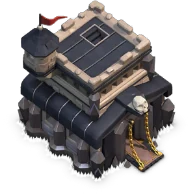

Stats by level
| Town Hall | Storage loot | Max per attack | Dark elixir | Max dark elixir | Search fee |
|---|---|---|---|---|---|
| TH1 | 20% | 200,000 | 6% | 2,000 | 5 |
| TH2 | 20% | 200,000 | 6% | 2,000 | 10 |
| TH3 | 20% | 200,000 | 6% | 2,000 | 50 |
| TH4 | 20% | 200,000 | 6% | 2,000 | 100 |
| TH5 | 20% | 200,000 | 6% | 2,000 | 150 |
| TH6 | 20% | 200,000 | 6% | 2,000 | 250 |
| TH7 | 18% | 360,000 | 6% | 2,000 | 350 |
| TH8 | 16% | 480,000 | 6% | 2,400 | 550 |
| TH9 | 14% | 560,000 | 5% | 4,700 | 750 |
| TH10 | 14% | 595,000 | 5% | 5,000 | 900 |
| TH11 | 14% | 700,000 | 5% | 5,500 | 1,000 |
| TH12 | 14% | 980,000 | 5% | 6,000 | 1,100 |
| TH13 | 14% | 1,260,000 | 5% | 7,500 | 1,200 |
| TH14 | 14% | 1,400,000 | 5% | 8,700 | 1,300 |
| TH15 | 14% | 1,540,000 | 5% | 9,200 | 1,400 |
| TH16 | 14% | 1,610,000 | 5% | 9,500 | 1,500 |
| TH17 | 14% | 1,680,000 | 5% | 9,800 | 1,600 |
| TH18 | 14% | 1,750,000 | 5% | 10,100 | 1,700 |

Where these numbers come from. Read from Clash of Clans' own game files, client build 18.600.3. They are exact for that build and do not reflect anything released after it, so verify in game before committing an upgrade.
Game values are read from Supercell's own game files, reproduced as fan content under Supercell's Fan Content Policy. Goblins Farm is not affiliated with, endorsed, sponsored, or specifically approved by Supercell, and Supercell is not responsible for it.
 Frequently asked
Why can I only steal a small part of someone's gold?
Because storage loot is deliberately capped. Only a set percentage of what a defender holds in storages is available to an attacker, and that percentage shrinks further when the defender's Town Hall is lower than yours. Collector loot is not capped the same way, which is why inactive bases with full mines are far more profitable than active bases with fat storages.
What is the loot cart?
A cart that appears on your own village after you are attacked, holding a share of the resources the attacker took. Tapping it returns those resources to you at no cost. It is easy to overlook behind buildings, so check for it every time you log in.
Is it better to farm collectors or storages?
Collectors, most of the time, because a much larger share of collector loot is stealable and collectors are usually the easiest buildings on the map to reach. Commit to a storage attack only when the loot preview is large enough to justify a full army and the losses that come with going into the core.
 Keep reading


This page is part of the free Clash of Clans wiki we maintain at Goblins Farm. We also build a farming bot for the game; the reference material here stands on its own and does not require it.
Goblins Farm is not affiliated with, endorsed by, sponsored by, or specifically approved by Supercell. Clash of Clans is a trademark of Supercell Oy. This material is unofficial fan content produced under Supercell's Fan Content Policy. Game values change with every update; always verify in-game before committing an upgrade.